Most people put real thought into getting to Salou and none at all into moving around once they are here. That is the correct order of priorities. The resort is small, flat and strung along a single seafront, and a fortnight can pass without anyone paying a fare or reading a timetable.
What follows is what exists, and when each thing is worth using.
Assume you will walk
Salou's built-up front runs roughly two kilometres end to end, from the Font Lluminosa at the northern roundabout, along the whole curve of Platja de Llevant, down to the old port at the Ponent end. Twenty-five minutes at holiday pace. Fifteen if someone has booked a table.
Nearly everything a visitor needs sits inside that strip or one street behind it — hotels, supermarkets, pharmacies, the bar terraces on Carrer Carles Buïgas, the beach itself. Families come back year after year partly because of this. Nobody has to be driven anywhere, and a child who falls asleep at dinner can be carried home rather than loaded into a car.
One exception. Cap Salou, the pine-covered headland closing the eastern end of the bay, involves a climb and a network of villa streets with intermittent pavements. It is walkable — forty minutes or so from the centre — but it is the one part of the resort where transport starts to make sense.
The promenade does the navigating
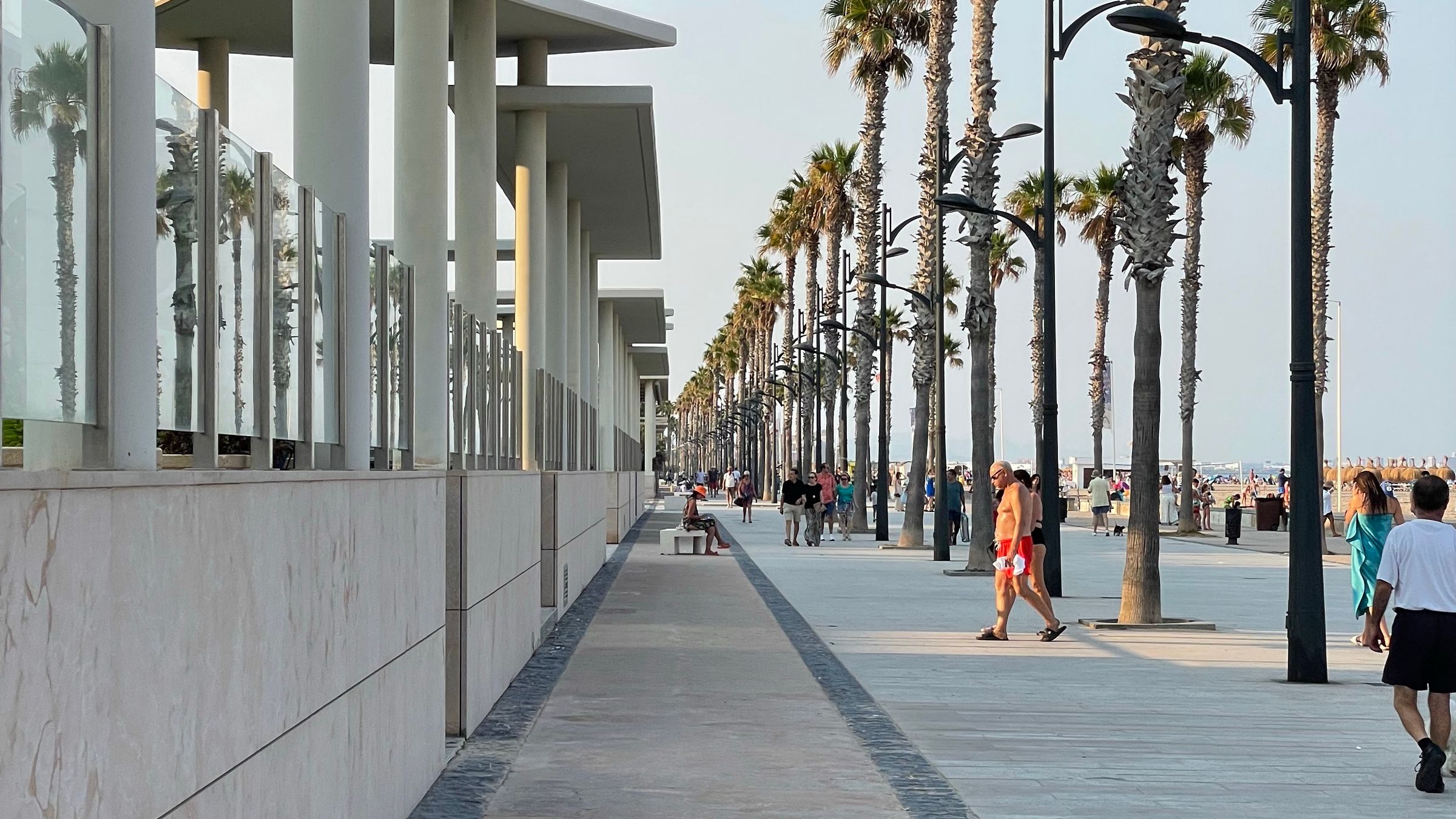
Passeig Jaume I is the spine of the place, and once you have understood it you have understood Salou. Something over a kilometre of wide, palm-planted walkway running the length of Llevant, sea on one side, hotels and terraces on the other, through traffic pushed inland. The palms are the tall, thin, faintly implausible sort that turn up on every postcard of the Costa Daurada, and they were planted early and deliberately, back when the resort was inventing itself.
Directions here are given in relation to it. The Font Lluminosa — the illuminated fountain at the top of the passeig, which performs with coloured water and music on summer evenings — anchors the northern end. At the far end, the port does the same job. Between the two you cannot really be lost.
On an August evening the promenade at eight o'clock is less a walkway than a slow-moving crowd. With a pushchair, allow double the time and expect to be stopped. It thins out considerably after half past ten, and in May or October it is simply a pleasant flat kilometre.
That little road train
A rubber-tyred tourist train — a tractor unit dressed as a locomotive, hauling two or three open carriages — works the seafront through the season, running along the front and out around the headland towards Cap Salou.
Judged strictly as transport it is poor. Within the centre it is slower than walking: it stops, it loops, it waits at junctions, and anywhere along the passeig your own feet will beat it comfortably. Nobody should use it to get from a hotel to dinner.
Judged as something else, it earns its place. The Cap Salou leg saves a genuine climb, the open sides catch whatever breeze exists, and a small child who has stopped negotiating about walking will sit still for twenty minutes and watch the coves go past. Services are seasonal and thin out sharply outside summer.
As a way of covering ground it is close to useless. As a way of ending an afternoon without a scene, it is the best value on the seafront.
Buses along the coast, and inland
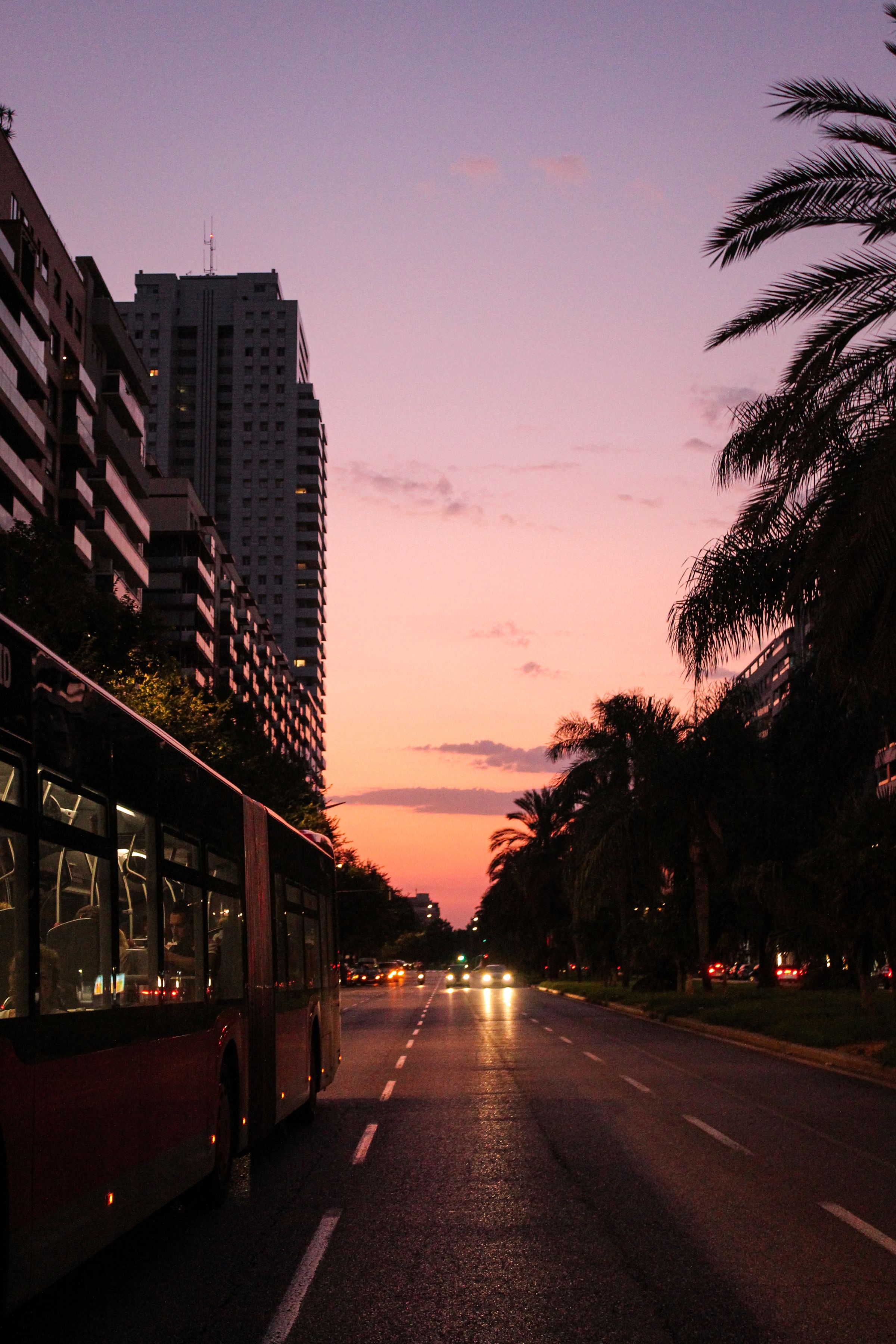
Local and interurban services are run by Plana, the operator that also works the airport route. Useful lines link Salou with La Pineda and Vila-seca to the north, Cambrils to the south, and Reus and Tarragona inland. Stops sit on the main roads a street or two back from the front rather than on the promenade itself, which is why a great many visitors never notice them at all.
Frequencies are good through the summer and noticeably thinner from November to March, when the resort empties and the timetable contracts with it. Fares are small, and tickets are bought from the driver.
| Where | From Salou | Usual way | Rough time |
|---|---|---|---|
| PortAventura | 2.5 km | Walk, bus or the station | 30 min on foot |
| La Pineda | 4 km | Local bus | about 15 min |
| Vila-seca | 4 km | Local bus | about 15 min |
| Cambrils | 7 km | Coast-road bus | about 20 min |
| Tarragona | 10 km | Bus, or train from PortAventura | 25–35 min |
| Reus | 13 km | Bus | about 30 min |
Where the taxis wait
Ranks stand at the obvious points — near the fountain at the top of the passeig, on the main road behind the beach, and down by the port — and fares are metered rather than negotiated. A hop across the resort costs very little, which is most of the reason a rank exists at all in a town this size.
Two moments will make you want one. Arriving or leaving with luggage from an address up on the headland or out towards Vila-seca. And two in the morning in August, when Carrer Carles Buïgas empties all at once and the queue at the rank becomes the longest wait of the holiday. Booking by phone in advance is worth the trouble on that second occasion.
PortAventura station, and the line that closed
Salou used to have a station of its own, on the old coastal railway that ran right along the shoreline through the resort. It closed in January 2020, when services were shifted onto a new inland alignment and the seafront tracks came up. The stretch that survived now forms part of the R17 Rodalies line, and the station left standing is PortAventura.
That station sits about two and a half kilometres from central Salou, beside the theme park and technically inside Vila-seca. Trains run from there up to Tarragona and on towards Barcelona. For anyone heading to the park it could hardly be better placed; for anyone staying on the seafront it means a bus, a short taxi, or a half-hour walk along roads with nothing whatever to look at.
Visitors booking rail tickets sometimes search for Salou and take the result at face value. Nothing arrives in Salou. Everything arrives at PortAventura, and the last two and a half kilometres are yours to solve — manageable with a rucksack, tiresome with two suitcases and a pushchair.
Bicycles, and the one climb
Flat ground makes a bicycle a reasonable way to cover the resort and the coast on either side of it. Hire shops open along the main streets through the season, most renting by the day or the week, and the road out towards La Pineda and Vila-seca is level the whole way.
Two cautions, both obvious once stated:
- Cap Salou is the exception to the flatness. The climb up from the bay is short but real, and the run back down is faster than most holiday cyclists expect.
- In July and August the streets behind the front carry heavy traffic and a great many pedestrians who are not looking. Riding through a summer crowd on the promenade is a poor idea, and in stretches it is not permitted anyway.
Parking is the difficult part
Here is the one thing in Salou that is genuinely awkward, and it deserves a blunt paragraph. On-street spaces in the centre fall under the paid blue-zone scheme through the season, the underground car parks near the front fill early, and hotel parking is usually charged on top of the room and often limited to a handful of bays. In August, finding a space within sensible distance of the seafront means circling, then paying, then doing the whole thing again the next day.
Which leads to a simple test. If the holiday is beach, promenade, theme park and dinner, a car is a liability rather than an asset. If you have brought one anyway, put it in the hotel space on the first day and leave it there until the morning you actually drive somewhere.
None of this needs deciding before you arrive. Work out where the main beach ends and the promenade begins, and the rest arranges itself around the walk. Bus routes and timetables are published by Plana, train times by Rodalies de Catalunya, parking zones and local rules by the town council, and general visitor information by the Salou tourist board.